
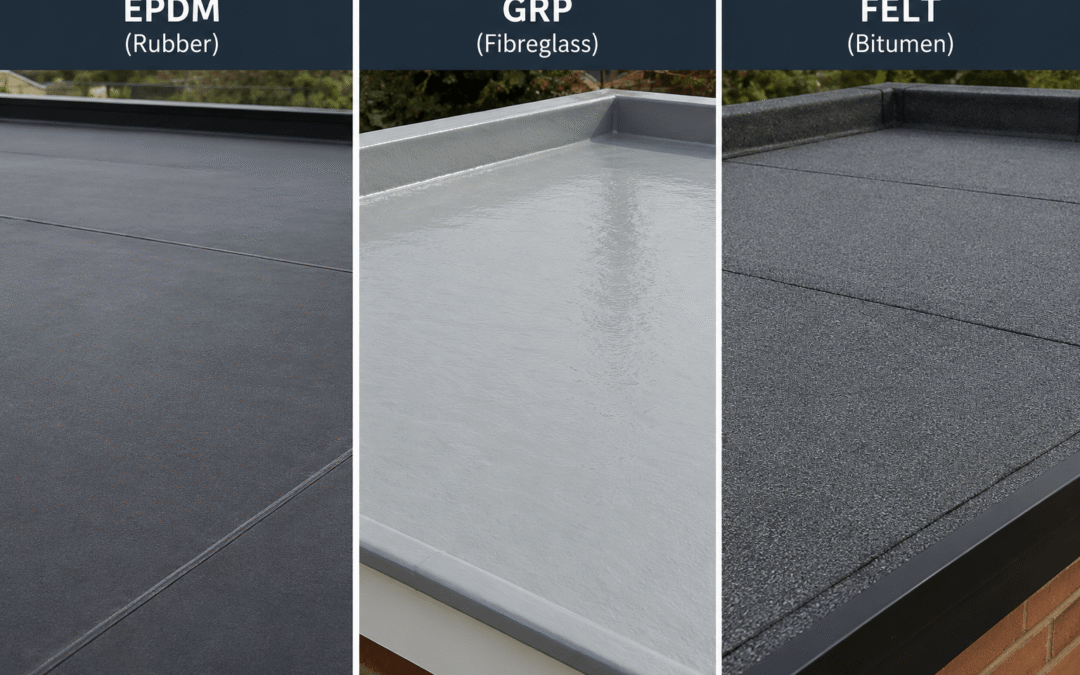
Sooner or later, every flat roof needs replacing. Whether it sits over a kitchen extension in Warrington, a detached garage in Wigan or a small commercial unit on the edge of the Peak District, the membrane that has quietly kept the rain out for the last twenty years will eventually give up. When it does, you have a real decision to make, because flat roofing is no longer a one-material trade. The three systems we use for flat roof replacements across the North West are EPDM rubber, GRP fibreglass and built-up felt. Each one has clear strengths, a few weaknesses and a different price point. This guide compares all three, so when the quotes start arriving you will know exactly what you are looking at.
Why flat roof material choice matters
A pitched roof fails one tile at a time. A flat roof fails as a whole system, because the membrane is the only thing standing between the timber deck and the weather. That makes the material decision unusually important. It sets how long the roof lasts, how it copes with the wet North West climate, how it looks from the bedroom window above, and how easy it is to repair when something eventually goes wrong.
It also affects the paperwork. If you are replacing a large part of a flat roof rather than patching it, the work normally needs to comply with current building regulations, which usually means bringing the insulation up to today’s standards at the same time. You can read the official guidance on building regulations approval on GOV.UK. A good contractor will handle all of this for you, but it is worth knowing about before you compare quotes, because a low price that quietly ignores the insulation upgrade is not really a low price at all.
EPDM rubber roofing: pros, cons and cost
EPDM is a synthetic rubber membrane, supplied in large sheets and bonded to the deck with adhesive. On most domestic roofs it goes down as a single piece, which means no joints and no seams across the main surface.
The pros. EPDM is the long-distance runner of flat roofing. Fitted properly, it routinely lasts 40 years or more, and many manufacturers back their membranes for decades. The rubber stays flexible in cold weather and stretches as the building moves, so it shrugs off the freeze-thaw cycles that crack harder materials. There are no hot works involved, installation is quick, and maintenance amounts to little more than keeping the surface clear of leaves and debris. If the membrane is ever punctured, repairs are simple and reliable.
The cons. The standard finish is matt black and fairly plain, which matters if the roof is overlooked from above. On larger roofs that need more than one sheet, the seams become the point to watch over the years. And because the membrane is relatively soft, dropped tools or sharp debris can puncture it.
On cost, EPDM usually sits in the middle of the three. Spread over its working life, it is often the cheapest option of all.
GRP fibreglass roofing: pros, cons and cost
GRP, usually just called fibreglass, is built up on the roof itself. A layer of resin and chopped strand matting is laid over a new timber deck, then sealed with a pigmented topcoat. The result is a single, seamless, rigid surface with no joints anywhere.
The pros. GRP gives the crispest finish of any flat roofing system. Edges and upstands are moulded neatly, the topcoat comes in a range of colours, and a non-slip finish can be added where the roof doubles as a balcony or walkway. It is tough underfoot, completely seamless and typically good for 25 to 30 years.
The cons. GRP has to be laid in dry, mild weather so the resin can cure properly, which can make scheduling awkward in a North West autumn. It is also rigid, so on buildings that move or flex, hairline cracks can appear around the edges and upstands over time. It is usually the most expensive of the three systems, and it almost always needs a brand new deck, which adds to the cost of the job.
For a roof you will look at every day, or one you want to use as outdoor space, that premium is often worth paying.
Built-up felt roofing: pros, cons and cost
Built-up felt is the system most people picture when they think of a flat roof. Modern torch-on felt has moved a long way from the thin, short-lived material that gave flat roofs a bad name in the 1970s. Today it is installed in two or three layers, finished with a mineral cap sheet, and performs far better than its old reputation suggests.
The pros. Felt is the cheapest of the three to install, it goes down quickly in most weather, and it handles awkward details, small roofs and complicated shapes well. A high-performance felt system, properly installed, should give you 15 to 20 years of service.
The cons. It has the shortest lifespan of the three, and it ages visibly, with blisters, cracking and bare patches appearing as the bitumen dries out. Installation involves hot works, which some commercial insurers ask questions about. And over the full life of a building, having to replace it more often can cancel out the lower upfront price.
For garages, sheds and projects on a tight budget, felt still earns its place.
Lifespan and warranty comparison
Here is how the three systems compare at a glance when professionally installed:
| System | Typical lifespan | Relative cost | Best suited to |
|---|---|---|---|
| Built-up felt | 15–20 years | Lowest | Garages, sheds, tight budgets |
| GRP fibreglass | 25–30 years | Highest | Extensions, balconies, visible roofs |
| EPDM rubber | 40+ years | Mid-range | Commercial units, long-term value |
Two caveats are worth adding. First, workmanship matters more than material. A well-fitted felt roof will outlast a badly fitted rubber one every time. Second, read warranties carefully. A long membrane guarantee from the manufacturer is not the same as a workmanship guarantee from the installer, and most flat roof failures start at the details: the edges, outlets and upstands, which are the installer’s side of the bargain. Ask anyone quoting for your roof exactly what is covered, by whom, and for how long.
Best material for extensions, garages and small commercial flats
For a home extension that is overlooked by bedroom windows, looks count. GRP’s clean lines and coloured topcoat usually win, with EPDM a close second where the budget is tighter. For garages and outbuildings, felt and EPDM both make sense: felt if you want the lowest price today, EPDM if you would rather fit it once and forget about it.
For small commercial flat roofs, workshops and offices, EPDM tends to be our recommendation. The long service life keeps disruption to a minimum, repairs are quick when they are needed, and the absence of hot works keeps insurers happy. You can see recent examples of all three finishes in our gallery, alongside roofing work across Wigan and the surrounding towns.
Every building is different though, and the right answer is sometimes not the one in the brochure. That is why we always look at the roof before we talk materials.
Get a flat roof quote from TRS
TRS Roofing & Guttering is a family business covering Wigan, Warrington, St Helens, Leigh and the Peak District towns of Buxton, Matlock and Bakewell. Flat roofing sits alongside our full range of roofing and guttering services, so whichever material suits your building, the same team handles the survey, the installation and the aftercare.
If your flat roof is coming to the end of its life, or you are planning an extension and want the material decision settled early, we will come out, measure up and talk you through the options without any pressure or jargon. Call 0800 956 7199 or use the contact form to arrange a free, no-obligation quote.